QuestionFinishing & repairBy The Hook Desk6 Nov 2026
I missed an increase three rounds ago. Can I fix it without undoing?
Whether to fix or undo depends on how visible the spot is, how many rounds back it is, and whether the piece is stuffed. There is a rule of thumb for each case.
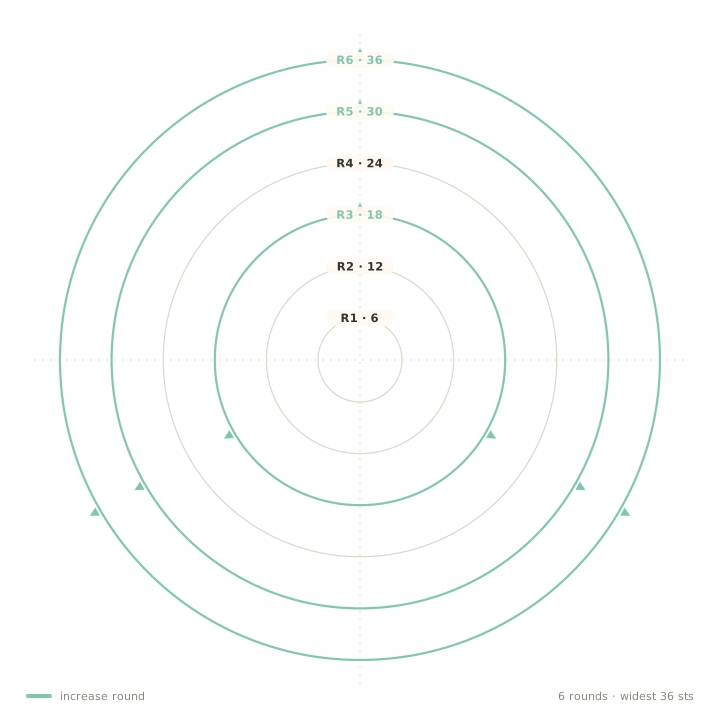
Step by step
Note 1The injected increase
Work a make-one: insert the hook under the horizontal bar that lies between the current stitch and the one before it, twist it slightly so it forms a loop, and work a sc into that loop. That adds a stitch without needing to go back.
Place it directly above the missing increase rather than at the current count's expected position. The point is to restore the column of stitches where the shaping needs it, not to make today's round add up.
R9When to undo instead
Undo if the missing stitch is on the visible right side of an unstuffed piece — a bag, a hat, a flat motif. An injected stitch in an unstuffed fabric sits slightly differently from its neighbours and shows in raking light, and there is nowhere for it to hide.
Undo if more than six rounds have passed. Six rounds of a 6-point schedule is six missing stitches, and six injected stitches in a row produce a visible ridge of their own. Below three rounds it is almost always worth a patch; above six it almost never is.
Note 3Preventing the next one
Missed increases almost always happen in the same place: the last increase of a round, two stitches before the join, where attention is already on the join. Put a marker in the first stitch of every increase round and, when you reach it again, check the count before continuing.
For 6-point rounds, count out loud in sixes as you work. Six is a small enough group to hold in working memory, and hearing the number land wrong is more reliable than seeing it.
Where it usually goes wrong
- Injecting an increase in the round it was missed on the other side of the piece, which shifts the whole silhouette by one stitch.
- Patching six rounds and then continuing as if nothing happened; the schedule needs the six stitches back, not six new ones in different places.
- Undoing 20 rounds to fix one stitch on a stuffed piece, where it would never have shown.