QuestionGauge & yarnBy The Hook Desk3 Sep 2026
How do I measure gauge for something worked in the round?
Almost every amigurumi gauge failure traces back to a flat swatch used to predict a round object. The measurement is easy; measuring the right object is the part that gets skipped.
Step by step
Note 1Working a round swatch
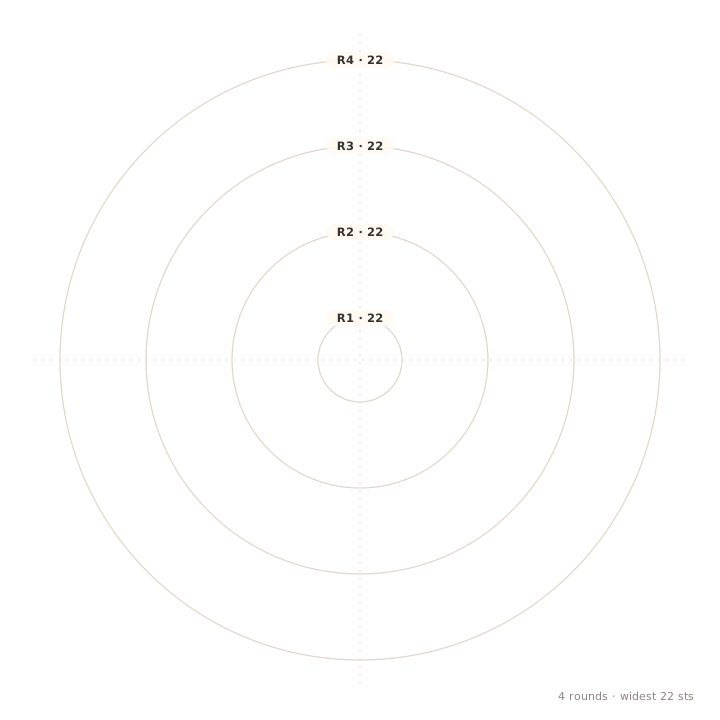
Start with a magic ring, work a flat disc to about 12 cm across, then stop increasing and work five straight rounds to make a shallow bowl. That gives you a flat middle to measure and a section of straight fabric to check row height in.
Measure across the centre three times at 90 degrees to each other and average. In DK weight on a 3.5 mm hook, an amigurumi-standard fabric is 22 sts and 24 rounds per 10 cm. If your rows read 20, your piece will come out taller than the pattern's numbers.
Note 2Why the flat swatch lies
Two effects stack. First, a turned row's edge stitches lean, and if you measure the whole width you include that lean. Second, most crocheters tighten slightly when working a continuous spiral because there is no pause at the turn.
The gap is not trivial: on a 30 cm amigurumi, a 6% stitch-count error is roughly 18 stitches of difference around the widest round. That is the difference between a pattern's decrease schedule landing where it should and running out of stitches two rounds early.
Note 3Using the numbers
Once you know your own round gauge, convert every pattern you use rather than fighting to match theirs: multiply the pattern's stitch counts by (your stitches / pattern stitches). A 6-stitch start becomes 6.6, which you round to 7 and then keep the increase rule at +7 per round.
Rounding is safe up to about 8%, because a stuffed piece forgives a stitch. Above that, the shaping schedule stops working: a 12-stitch start rounded to 13 gives you a 13-spoke disc, and the pattern's six-section decrease rounds will not divide.
Where it usually goes wrong
- Measuring a swatch the day you made it and then again after blocking and getting two different answers.
- Counting the magic ring's first round twice because the tail looks like a stitch.
- Matching stitch count but ignoring row count, then finding the piece is the right width and the wrong height.