QuestionRounds & spiralsBy The Hook Desk2 Oct 2026
Why does every joined round start further to the right, and how do I stop it?
A staircase edge is not a mistake — it is what joined rounds do when the join is treated loosely. The fix is arithmetic plus one habit change.
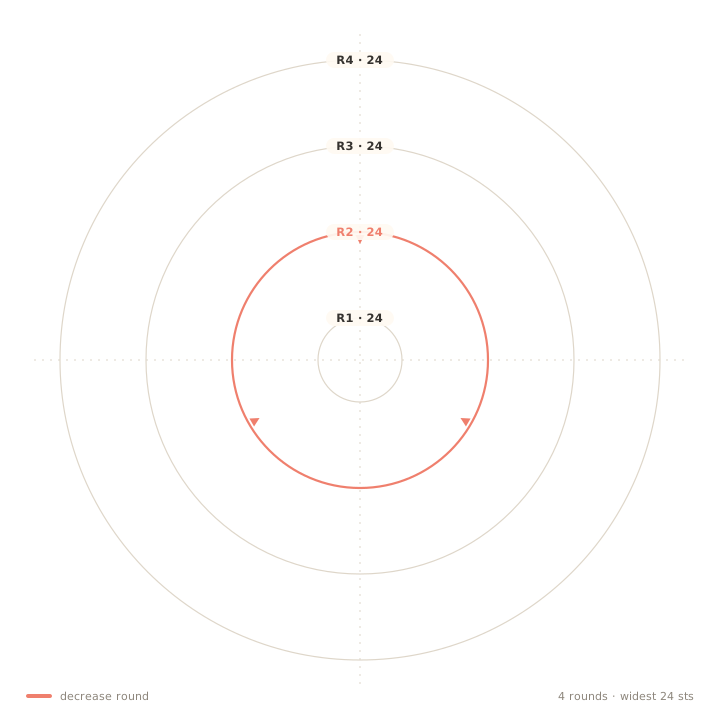
Step by step
Note 1Where the drift comes from
You finish round 1 with a slip stitch into the first stitch. That slip stitch is not a stitch in the count, but it lives in the same place. You then chain 1, which sits above the slip stitch. The next round's first real stitch goes into the same stitch you joined into, so it is one position to the right of where round 1 started.
Do that eight times and the start point has moved eight stitches around the circle. On a 30-stitch round that is more than a quarter of the way round, which is why colour stripes in joined rounds spiral instead of stacking.
R4 · 24 stsTwo habits that stop it
First, work the joining slip stitch into the first stitch of the round and then work the next round's first stitch into that same first stitch. This keeps the join in a fixed column. Second, keep the turning chain to the minimum that still gives you height: ch 1 for sc, ch 2 for hdc, ch 3 for dc, pulled tight.
The combination gives a vertical line of joins instead of a staircase. You will still see the line; you will no longer see the edge climbing to the right, which is what makes a piece look hand-made in a bad photograph.
Note 3When to abandon joined rounds
If the piece is taller than about 10 cm and the join lands where people will look at it, switch to a spiral. Joined rounds are genuinely better only for flat discs, for striped work where you want the colour boundary to be a countable edge, and for pieces that will be seamed on that side anyway.
For a hat worked bottom-up, a good compromise is joined rounds to the crown decreases, then spiral from the first decrease round. The join disappears into the shaping.
Where it usually goes wrong
- Working the first stitch of the new round into the second stitch, which both drifts the join and loses a stitch.
- Counting the slip stitch in the round total, which makes every round one stitch longer than the last.
- Chaining 2 or 3 for sc 'to be safe'. An oversized turning chain is itself a visible step.