QuestionRounds & spiralsBy The Hook Desk24 Aug 2026
Spiral or joined rounds — which one should I use?
This is a choice you make once per project and cannot fix later. Both produce a tube; they differ in where the round boundary lives and in what that costs you.
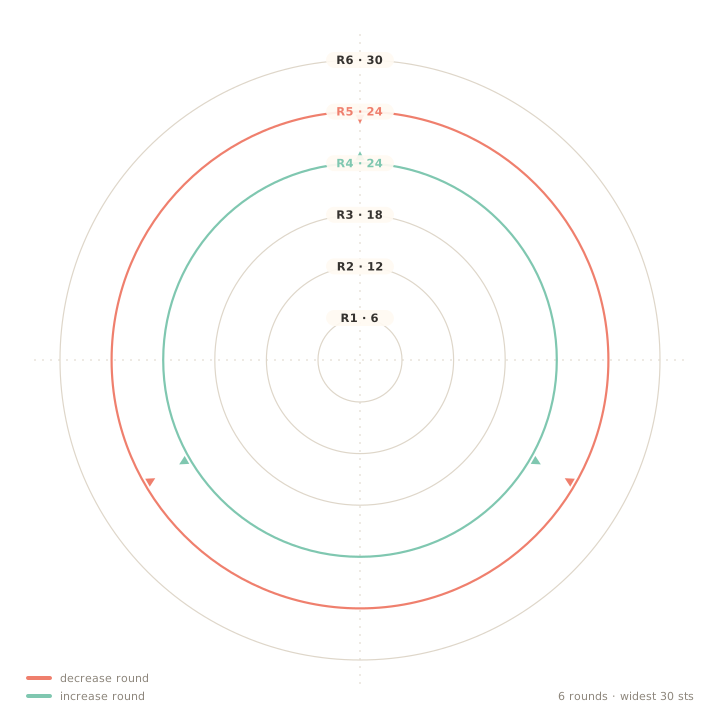
Step by step
Note 1How spiral rounds work
In a spiral you never join and never turn. Round 2 starts in the first stitch of round 1 and keeps going, so the fabric is a continuous helix. Nothing marks the round change, which is exactly why stuffed shapes look seamless: there is no line running up the side of the ball.
The cost is counting. You need a marker in the first stitch of the round, moved every round, because there is no visual cue. You also get a jog when you change colour mid-spiral — the new colour starts one stitch higher than the old one ended.
Note 2How joined rounds work
In joined rounds you finish each round with a slip stitch into the first stitch, then chain the turning height and start the next round. The round boundary is a real, visible line running up the work. For a flat disc, that is useful: you can lay it down, count the rounds from the outside, and see immediately if one is short.
The cost is the join itself. The slip stitch and the turning chain both take up space, which leaves a slightly thicker ridge and, if you are careless, a visible staircase where each round starts one stitch to the right of the last.
Note 3Choosing in one sentence
If the piece will be stuffed, wet-blocked into a round shape, or photographed from an angle where a seam would show, spiral it. If the piece is flat and will be joined to other flat pieces, or if you are working stripes of two or three colours, join the rounds so the boundaries land where you expect.
A practical hybrid that works well: spiral the body of an amigurumi and use joined rounds for the flat base disc, then switch. The base's seam is hidden under the piece anyway.
Where it usually goes wrong
- Spiralling without a marker and then discovering the piece is one round taller on one side.
- Joining with a chain-1 that is counted as a stitch — it is a turning chain, not a stitch.
- Changing colour in a spiral and expecting the stripe to be level. It cannot be; move the join to the back of the piece instead.