QuestionShapingBy The Hook Desk9 Oct 2026
How do I get an even cylinder instead of one that bulges in the middle?
The bulge is the single most common shape fault in amigurumi limbs, and it is caused by treating the disc rule as if it applies to every round of the piece.
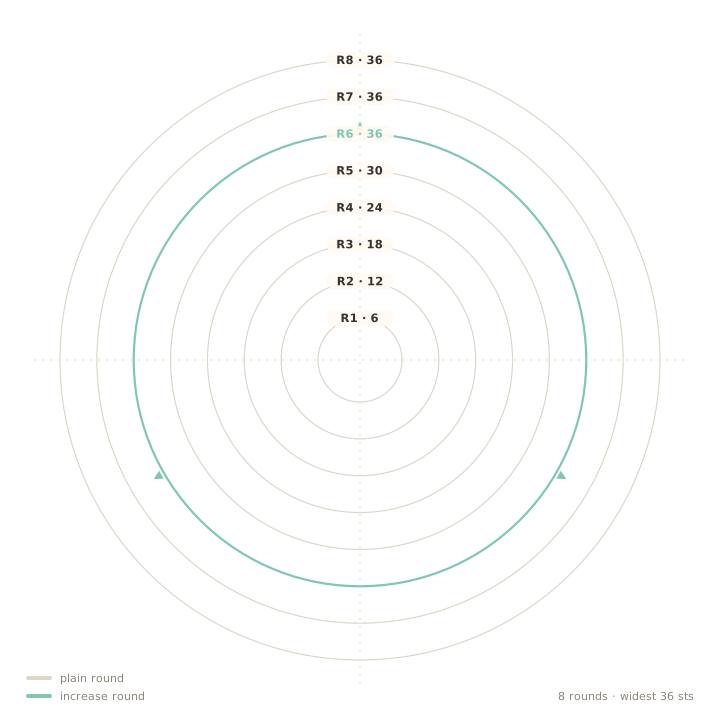
Step by step
R6 · 36 stsThe disc rule stops applying at the corner
For the flat top of a cylinder, add 6 stitches per round: 6, 12, 18, 24, 30, 36. At 36 you have a disc whose diameter equals the tube's width. From that point on, adding any stitch makes the cylinder wider than the top, and the extra width has nowhere to go but outward.
The visual result is a ring of slack about 1.5 cm below the top, exactly where most people are still following 'increase in every round' out of habit.
Note 2The one plain round that fixes it
After the final increase round, work exactly one round with no increases. This round absorbs the transition: the stitches in it lean slightly outward at the top and vertically at the bottom, forming the rounded shoulder a real cylinder has rather than a hard crease.
Then work straight rounds. Measure the cylinder's circumference after four straight rounds; if it is wider than the disc's diameter, you are still increasing and need to back up.
Note 3Tapering in and out without a step
To narrow a cylinder — a leg going down to a foot — decrease on alternate rounds rather than every round, and stagger the decreases the same way you stagger increases. Decreasing every round at six points gives a visible cone; alternating gives a gentle taper over twice the height.
To widen — a body going into shoulders — add the new stitches one round late and one stitch in from the edge, so the widening happens inside the silhouette instead of at the outline.
Where it usually goes wrong
- Keeping the disc increases running while also starting the straight section, which is what produces the bulge.
- Using a stitch marker only at the start of the round and never checking circumference, so the bulge is discovered after the piece is stuffed.
- Skipping the plain transition round because it feels like wasted work.