QuestionFoundationsBy The Hook Desk30 Sep 2026
What is a chainless foundation and when is it worth the trouble?
Tight foundation chains are the reason a scarf is 4 cm narrower at one end and a blanket edge refuses to lie flat. The chainless method removes the problem at the source.
Step by step
Note 1How the first stitch is built
Chain 2. Insert the hook into the first chain, yarn over, pull up a loop, yarn over and pull through one loop only — that single loop is the 'chain' part. Then yarn over and pull through the remaining two loops, which completes a sc. You now have two stitches: a real sc and its built-in chain base.
For the next stitch, insert the hook under the two loops at the base of the stitch you just made rather than into a chain. Every subsequent stitch is built the same way: the base loops of the previous stitch are your insertion point.
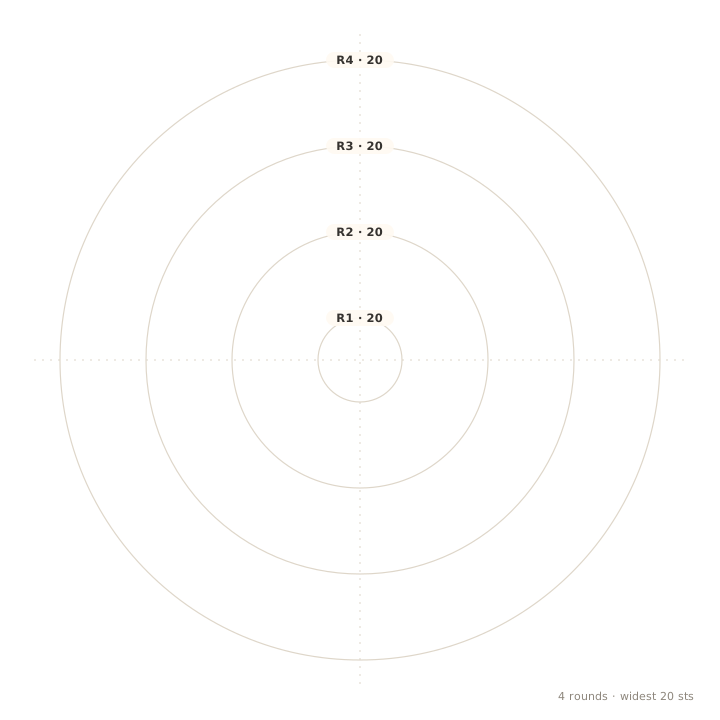
R1 · 20 stsWhat it costs and what it saves
The foundation row takes roughly 1.5 times as long as a chain plus a plain row, because you are doing two things per stitch. What you save is the entire second row, plus the tightness problem: a chainless foundation stretches 30-40% more than a chain edge on the same yarn.
It also gives you a clean bottom edge with no ridge. A chain-based start leaves a visible line of chain bumps along the bottom of the work, which shows in any garment where the hem is exposed.
Note 3Where it is the wrong tool
Amigurumi, round pieces and any base that will be joined to something else: the extra stretch works against you because the piece needs to hold a fixed shape, and the base is hidden anyway.
It is also awkward in very thick yarn, where the base loops are hard to find, and in very fine thread, where the two-part stitch becomes fiddly at 1.25 mm. Between about DK and worsted it is at its best.
Where it usually goes wrong
- Pulling through two loops instead of one at the 'chain' step, which collapses the foundation back into a normal sc.
- Inserting the hook into a chain stitch out of habit, which reintroduces the tight edge you were avoiding.
- Using a hook one size smaller 'because foundations are loose' — the whole point is that it does not need to be.