QuestionShapingBy The Hook Desk17 Aug 2026
How many stitches should I add in each round of a flat circle?
The flat circle is the one shape where a single arithmetic rule replaces guessing. If the circle is curling or ruffling, the count — not the tension — is almost always what is wrong.
Step by step
R4 · 24 stsThe rule and why it works
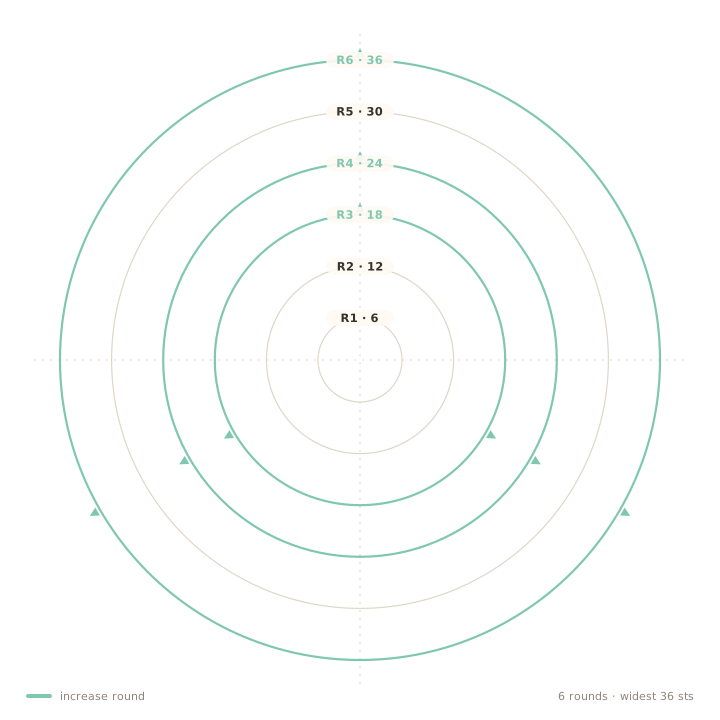
Circumference grows linearly with radius, so a flat disc needs a constant number of new stitches per round — the same number you started with. A 6-stitch start means 6 increases in every round: 6, 12, 18, 24, 30, 36, 42.
Where those increases sit is what keeps the disc flat rather than a hexagon. In round 3 you work 1 sc then an increase; in round 4, 2 sc then an increase; in round 5, 3 sc then an increase. Worked with no slack, the increases line up in six spokes and the circle reads as a hexagon with six corners.
Note 2Reading the disc: curling versus ruffling
After four rounds, lay the disc on a table. Edges that lift into a bowl mean too few stitches — you have been skipping the increase, or the last stitch of each round is being lost. Edges that ripple in waves mean too many, usually because the joining slip stitch is being counted as a stitch.
Count one round rather than trusting the pattern. Round 5 of a 6-start disc must have exactly 30 stitches. If it has 29, the missing stitch is at the join, every round, and the error compounds by one stitch per round.
Note 3Scaling to other stitch heights
The rule is the same but the start changes with stitch height: 6 for sc, 8 for hdc, 12 for dc. A double-crochet disc growing by 12 per round stays flat; one growing by 6 curls immediately because dc is roughly twice as tall as sc.
For hdc, start with a magic ring of 8 and add 8 every round. If you are working a coaster that must lie dead flat, go up one hook size before changing the arithmetic — hook size fixes stiffness, stitch count fixes flatness.
Where it usually goes wrong
- Counting the joining slip stitch as a stitch, which adds one phantom stitch per round.
- Spreading the increases evenly instead of stepping them — it hides the spokes for three or four rounds, then the disc ripples.
- Changing hook size to fix a curl that is actually a stitch-count error.