QuestionGauge & yarnBy The Hook Desk21 Oct 2026
Does hook material actually change my gauge?
Hook material is the last variable people consider and the easiest one to test. It is also the reason a project started on one hook can drift when you switch to another mid-piece.
Step by step
Note 1Friction, and why it shows up as gauge
Every loop you pull up has to slide over the hook's shaft. A smooth aluminium hook lets the yarn slide with very little resistance, so the loop ends up slightly larger. A bamboo hook grips, the loop stops sooner, and the stitch is 3-5% smaller for the same hand motion.
The effect compounds on tall stitches: a dc has more shaft contact than an sc, so the aluminium-versus-bamboo gap is wider on a dc fabric than on a single crochet fabric.
Note 2Resin, ergonomic and coated hooks
Resin and plastic hooks sit closest to aluminium in friction and are the lightest, which matters over a long session. Metal hooks with an ergonomic grip change the angle of your wrist more than the friction, and that angle change alone can move gauge by 2%.
Coated hooks — the ones with a coloured finish — sit between aluminium and bamboo. If you have hand pain, choose by handle shape first and material second, then re-swatch; the gauge difference is smaller than the difference a painful grip makes to your tension.
R3What to do if you must switch mid-project
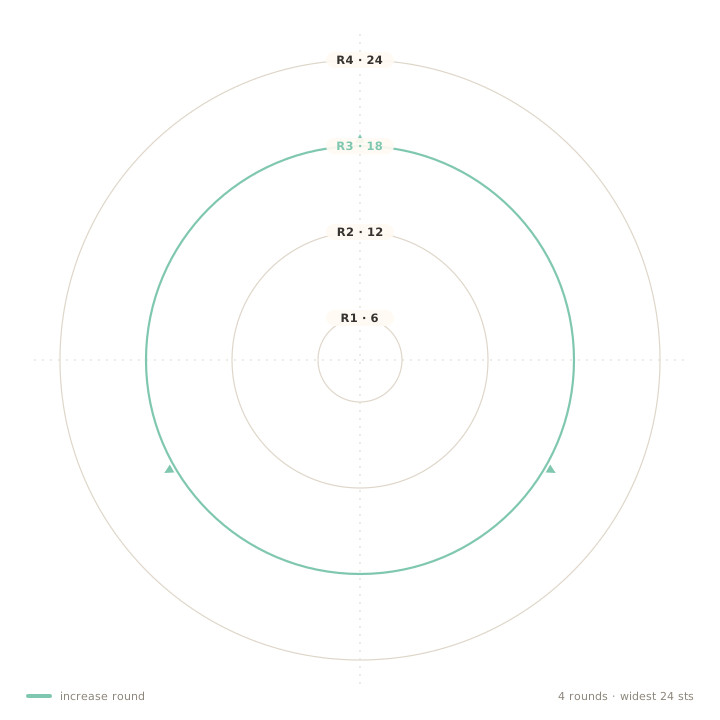
Switch at a round boundary, never mid-round, so any gauge change is a clean step rather than a wobble in the middle of a round. Then compensate: going from bamboo to aluminium is like going up a quarter hook size, so work one plain round before continuing the shaping.
If the change is forced and the piece is a stuffed shape, work the rest of the piece with the new hook and accept the 3% difference. It disappears into the stuffing, and unstuffing a half-finished piece is far worse than a slightly uneven one.
Where it usually goes wrong
- Switching hooks mid-project between materials and blaming the pattern for the resulting bulge.
- Buying a full set of one material because it is cheap, then discovering your gauge only holds on one of the five sizes you actually use.
- Assuming a bigger handle means a looser gauge. Handle size changes your grip, not the friction on the shaft.