QuestionFinishing & repairBy The Hook Desk28 Oct 2026
How do I sew limbs on straight so the toy is not lopsided?
Placement errors on toys are almost never about sewing skill. They come from judging symmetry by eye on a three-dimensional object, which the human visual system is bad at.
Step by step
Note 1Why your eye fails at this
When you hold a ball and look at it, you see one side. Your brain fills in the back. Move your hand half a centimetre and the whole image shifts, so you cannot compare two positions that you saw at different moments.
A photograph freezes both sides in one image and lets you compare them directly. That is the entire trick, and it is why a phone photo catches a 4 mm asymmetry that three minutes of squinting did not.
Note 2The pin-first method
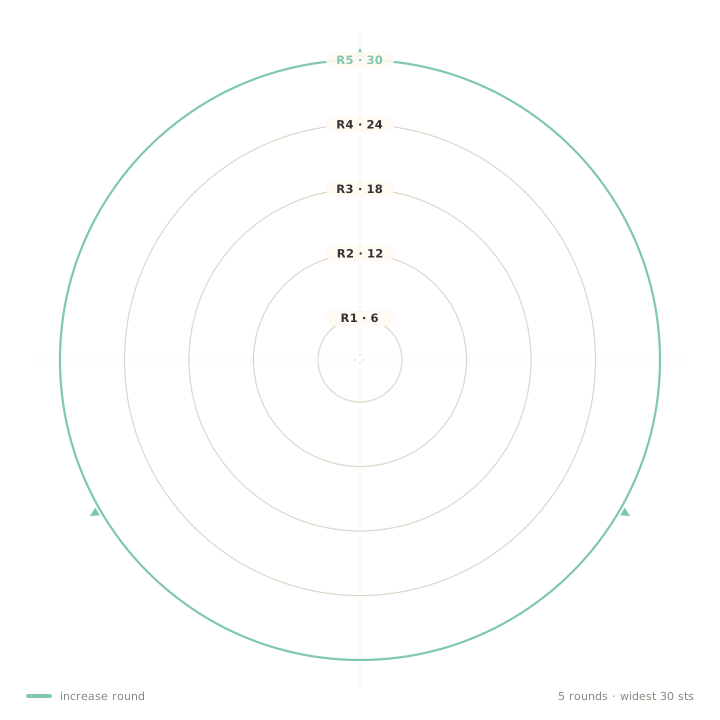
Insert a pin where you think each limb goes, pushing it through the body at the same height on both sides. Then count the rounds: if the left arm is pinned 12 rounds below the neck, the right one must be too. Round counting is exact in a way eyeballing is not.
Photograph front and side, look at the photos, adjust both pins together until the photo looks right. Only then pick up the needle. If both pins move, the placement is being corrected; if only one moves, you are matching to an error.
Note 3Sewing so the joint does not wobble
Use the tail you left on the limb, not a new length of yarn. Take one stitch into the body, then one into the limb, alternating, and work a full circle around the joint so the load is spread over 12-16 stitches rather than concentrated at four.
For anything that will be pulled — arms on a toy a child carries — go round twice. On the second pass, offset each stitch by half a stitch so the two passes interlock. The joint then fails by tearing the fabric, not by coming loose.
Where it usually goes wrong
- Sewing one limb, then holding the toy at arm's length to place the second. The error you are matching is now baked in.
- Measuring from the bottom of the body instead of from the neck. Bases are often off-centre on a hand-made piece; the neck is the reference.
- Using a 4-point attachment for a limb that will carry weight. Four stitches cannot hold 200 g of stuffing under load.